Atom Doodle
An AI-native learning companion for parents of preschoolers, aged 2–6, designed to turn everyday household materials into personalised, screen-free STEAM learning moments.
Built end-to-end from product strategy to AI orchestration, balancing developmental milestones, engagement patterns, and parent cognitive load.
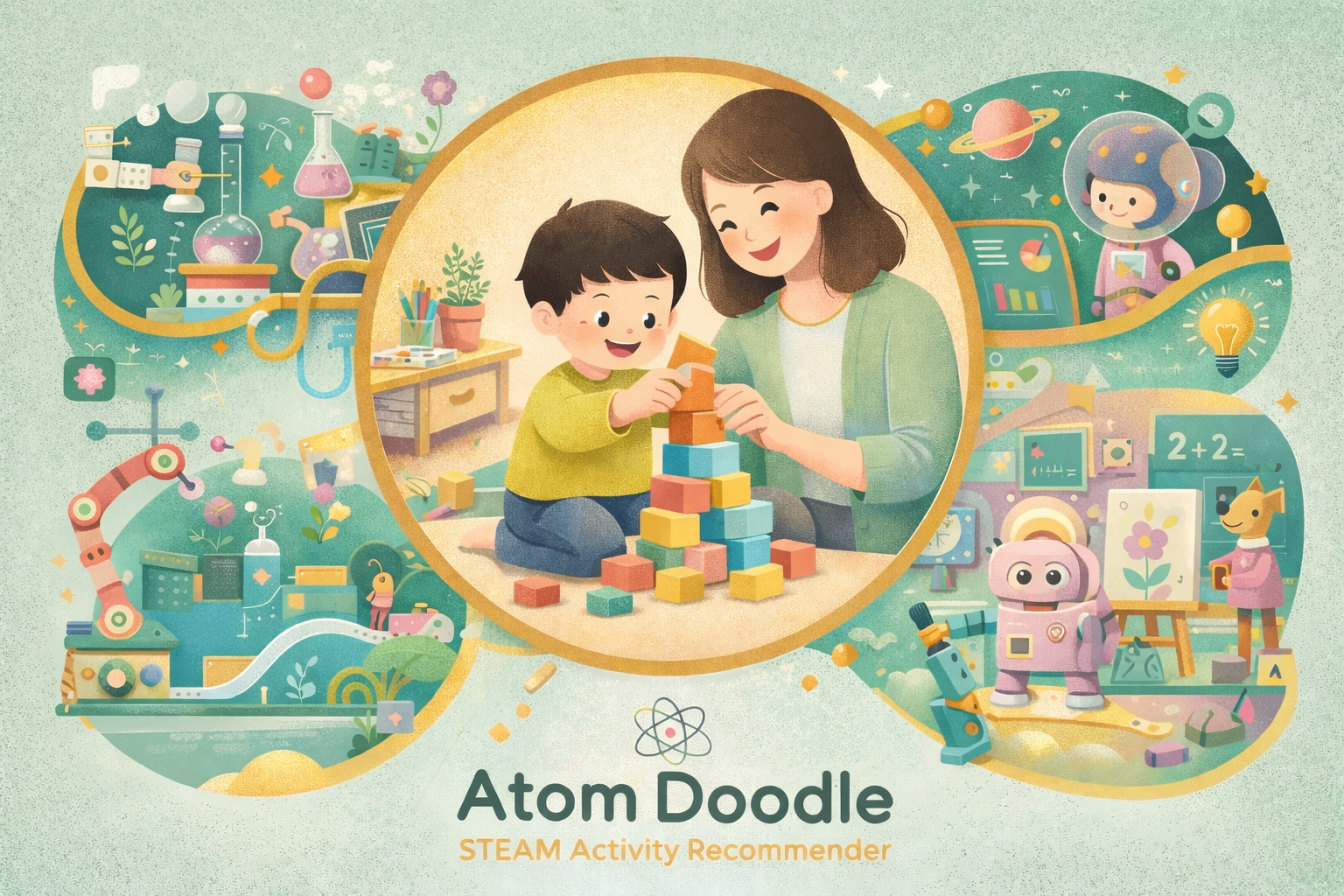
An AI-native learning companion for the kitchen-table years.
Designed for tired parents who want meaningful learning without constant screen time, expensive subscriptions, or toy fatigue.
The system personalises activities using:
- developmental readiness,
- child interests,
- engagement history,
- available materials at home,
- and milestone progression.
The goal is not more screen time for children, it is more confident, connected, hands-on learning and bonding between parents and children.
Every layer is intentional: Claude seeds and generates activities, Nano Banana renders each activity's illustration, Google Stitch drafted the first designs that became design.md, and Lovable + Supabase tie it all together.
“We have so many toys and don’t know how to use them properly. I don’t want to keep buying more.”
Parents of preschool-aged children (ages 2–6) often struggle to find developmentally appropriate, evidence-based STEAM activities that match their child's current interests, available materials, and skill milestones. Existing resources are fragmented across Pinterest boards, parenting blogs, and educational apps, with no unified system that personalises recommendations based on a child's learning progression and flags missed developmental milestones in time for parents to act.
Builder. Designer. Systems thinker.
Each decision shown below came from a real prompt or trade-off during the build — captured as a one-line conviction.
Parents rarely ask for activities in educational language. They say things like “We only have cardboard boxes”, “My child likes dinosaurs", “We have 10 minutes before dinner.”
The generation system was designed to translate messy, real-world parent context into developmentally appropriate, material-aware activities.
AI generation with human informed constraints.
Activities are not infinitely generated but shaped by developmental readiness, milestone tracking, repetition logic and expert-informed learning scaffolds vetted by early childhood educators
Built a "seed + generate" model with similarity check.
* 15 curated activities = quality control baseline, fast load, no latency on first use * On-demand generation via Claude API = infinite scalability, personalisation at depth
Pulled the palette into image generation.
design.md became the source of truth for Nano Banana prompts — so every generated activity illustration sits inside the same 'Sophisticated Whimsy' palette as the UI.
Cache with invalidation, not TTL alone.
24h recommendation cache in a table, with a DB trigger on activity_ratings that clears the cache the moment a child completes anything new.
Cold-start → hybrid → personalised.
Three recommendation tiers driven by completion count (<5, 5–15, 15+). New users get popular activities; veterans get full personalisation that avoids 1–2★ history.
Trust scaffolding.
Feedback loop — a simple ⭐ after activity completion. This does two things: makes parents feel in control, and gives you signal to improve recommendations
Seeded the activity library and generates new activities on demand from a parent's chat prompt.
Drafted the first screens. Exported as design.md, then handed to Lovable.
Orchestrated the full app — TanStack routes, Supabase migrations, edge functions, frontend.
Generates one illustration per activity, prompted with the design.md palette.
Three surfaces, one milestone-aware loop.
The app is intentionally designed for parents, not children.
Children engage primarily through screen-free, hands-on activities, while the app supports the adult in planning, adapting, and tracking developmental learning.
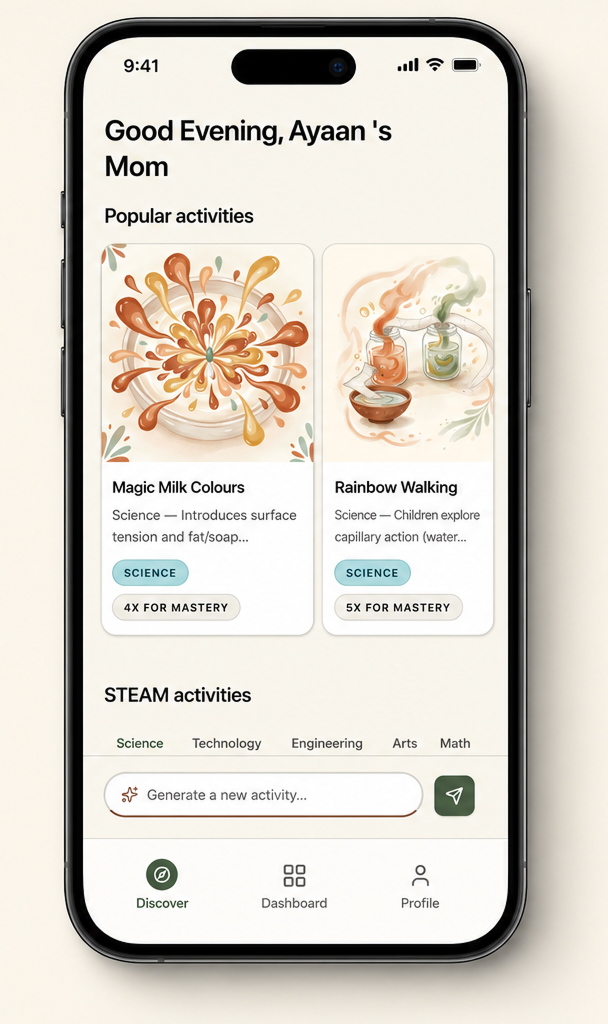
Recommendations that actually know the kid.
Greeting tuned to the parent's relationship and time of day. ‘Popular this week' for cold start. STEAM tabs to balance. A chat bar that takes ‘we only have toilet roll tubes and crayons' and returns a brand-new activity, generated by Claude, illustrated by Nano Banana, written into the DB so the next parent benefits too.
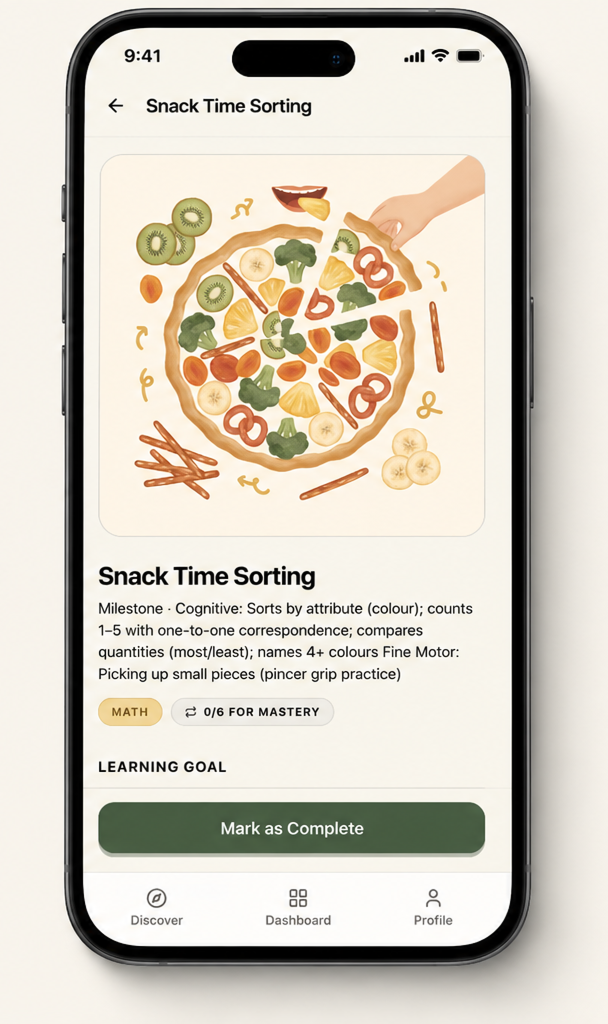
Parent-readable instructions, a Wow Moment, a mastery bar.
Each activity is connected to a milestone and a STEAM pillar. A ‘Wow Moment' highlights what to watch for in real time. Instructions include personalisation for child's likes and mastery tip after the first completion. ‘Mark as Complete' guides popularity and ratings help improve activity quality.
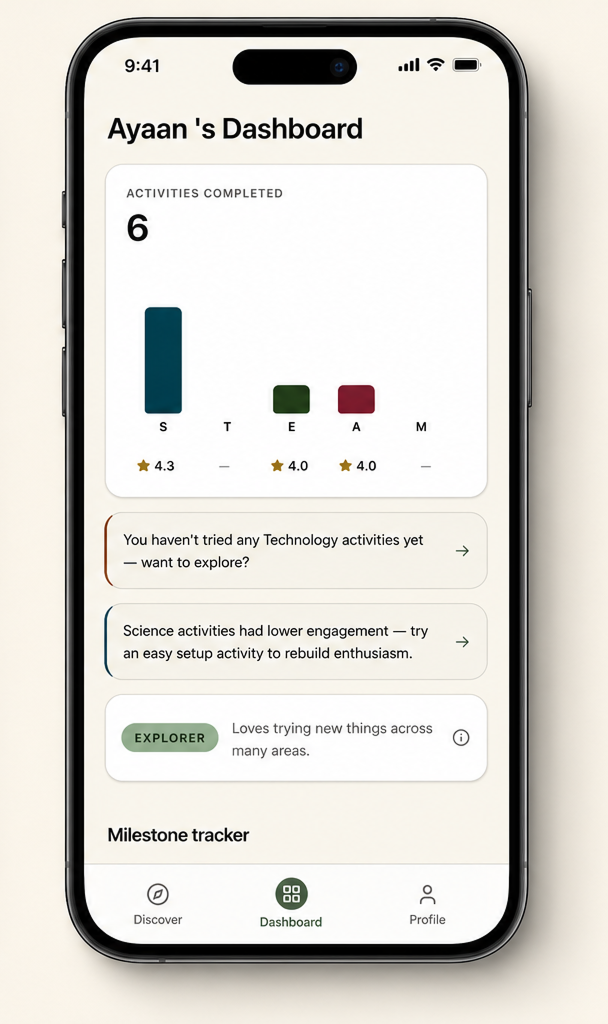
Pillar balance, mastery streaks, missed-milestone alerts.
The dashboard was designed to gently support parental awareness —not create performance pressure. Milestones, repetition prompts, and pillar balance are framed as guidance systems that help parents notice opportunities for growth without turning learning into optimization.
Atom Doodle is the case study version of how I work: write the system on paper, prompt the first version into existence, then make a hundred small product decisions that turn ‘an AI app' into something a parent actually opens on a Tuesday morning.